
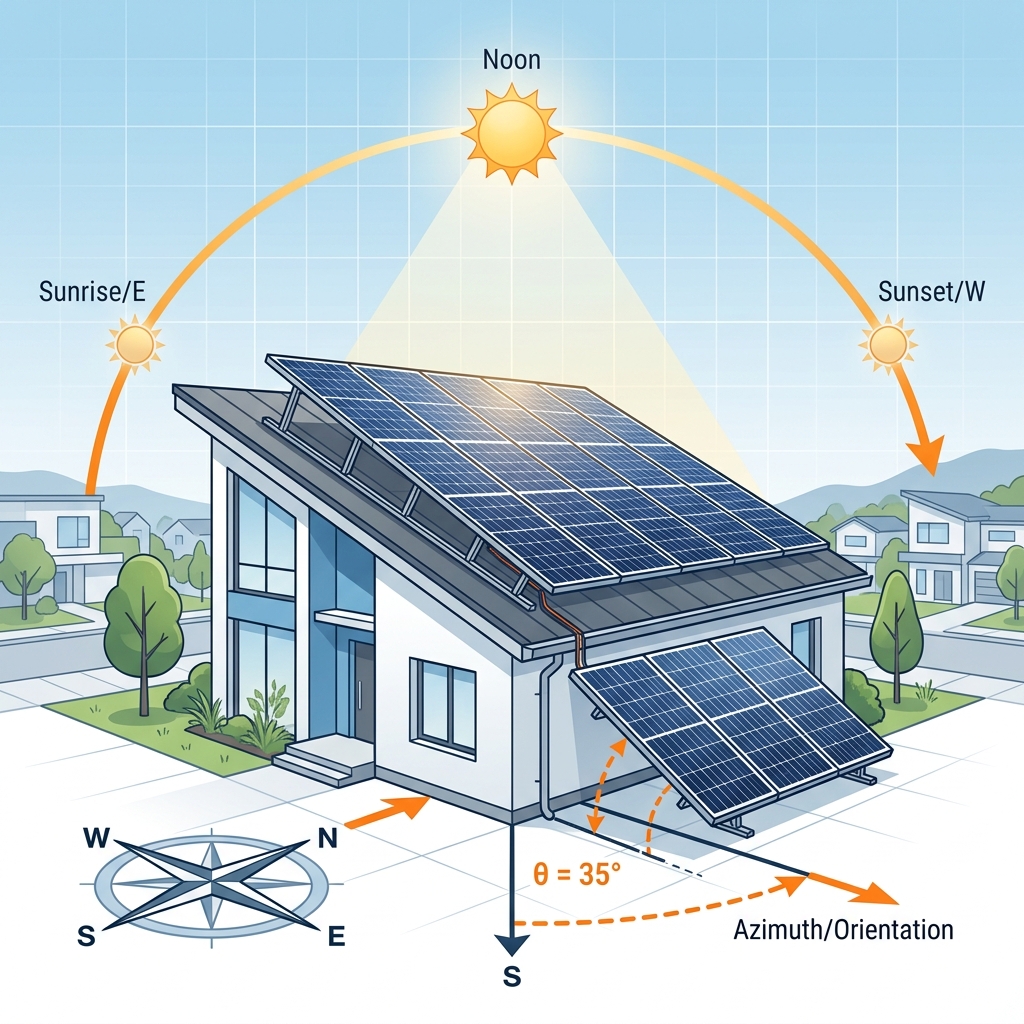
The direction and tilt angle of your solar panels directly impact how much electricity they generate. Getting this right is one of the most important decisions in any rooftop solar installation.
Ideal direction for India:
Since India is in the Northern Hemisphere, solar panels should ideally face TRUE SOUTH. This ensures maximum exposure to sunlight throughout the day.
However, not every roof faces south. Here's what to expect:
- South-facing: 100% optimal generation
- South-East or South-West: 95-97% generation (excellent)
- East or West-facing: 80-85% generation (still viable)
- North-facing: Not recommended — significant generation loss
Ideal tilt angle:
The optimal tilt angle roughly equals your location's latitude. For Central India (Bhopal, Indore):
- Latitude: ~23 degrees
- Optimal fixed tilt: 20-25 degrees
- Summer adjustment: 10-15 degrees (flatter)
- Winter adjustment: 30-35 degrees (steeper)
Most residential installations use a fixed tilt of 20-25 degrees, which provides the best annual average.
Shadow analysis matters:
Even the perfect orientation is wasted if shadows fall on your panels. Trees, water tanks, parapets, and neighbouring buildings can cast shadows that dramatically reduce output. SolarWale conducts a detailed shadow analysis during every site audit.
Flat roof advantage:
Indian homes commonly have flat RCC roofs, which is actually ideal — it gives complete freedom to set the perfect orientation and tilt using mounting structures.
SolarWale uses professional solar design tools to calculate the exact orientation and tilt for your specific roof, maximizing generation year-round.